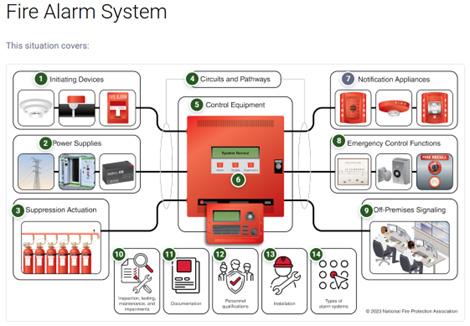
There are many functions that are served by the fire alarm system, and it all may be a bit confusing to someone new to fire alarms. So I decided to create a visual guide to fire alarm basics.
Once one understands the different functions and components of a fire alarm system, it’s time to start looking at the different codes and standards that cover the proper design, installation, and maintenance of a fire alarm system. This blog will introduce those different codes and standards and introduce how they apply to fire alarm systems.

Image from NFPA LiNK DiRECT® Situation: Fire Alarm Systems
Applicable Codes and Standards
I am going to talk about many different codes and standards in this blog, but it’s important to understand that not all these codes and standards may be applicable in your jurisdiction, and there may be different editions that are referenced. These are all different examples of codes and standards that a jurisdiction may refer to in legislation as requirements that need to be followed. Another thing to pay attention to is that many jurisdictions will also amend or make changes to the requirements when they reference them. Make sure to look up the applicable codes and standards as well as any amendments in the jurisdiction in which you are working.
NFPA 72, National Fire Alarm and Signaling Code
NFPA 72®, National Fire Alarm and Signaling Code®, is a design standard that outlines how a fire alarm and signaling systems needs to be designed. It will not tell you when a fire alarm system is needed or even the type of initiation or notification required—those requirements will come from the applicable code (see the different codes below).
What NFPA 72 will tell you is how the initiation and notification devices need to operate when required by another code. In addition to the design of a fire alarm system, NFPA 72 also covers the required inspection, testing, and maintenance of a fire alarm system throughout its lifespan.
NFPA 70, National Electrical Code (NEC)
NFPA 72 covers the design of a fire alarm system, including how all the circuits and pathways need to operate and where the equipment needs to be located, but it refers to NFPA 70®, National Electrical Code® (NEC) for the installation of wiring, cable, and equipment.
Typically, the fire alarm designer will apply the requirements of NFPA 72 in their design and then an electrician will install the system applying the requirements from the NEC. Primarily, the requirements for fire alarm system installation are going to be found in Article 760 of the NEC. Article 760 will provide requirements for things like cable and wire type, junctions, protection of wiring, securing of wiring, and firestopping of wiring.
Below is an example of enhanced content from Section 12.2.3 of NFPA 72 in NFPA LiNK® showing the types of requirements covered in Article 760 of the NEC.

NFPA LiNK Enhanced Content Illustrating NFPA 70 Article 760 Requirements
NFPA 101, Life Safety Code
NFPA 101 is an occupancy-based code with occupancy-specific chapters found in Chapters 12¬–42. The applicable occupancy chapter provides a complete roadmap to direct the user to all needed portions of the core chapters. The core chapters are Chapters 1–11 and Chapter 43, Building Rehabilitation.
Chapter 9 is the core chapter titled Building Service, Fire Protection, and Life Safety Equipment, which includes Section 9.6, Fire Detection, Alarm, and Communication Systems. This section first references NFPA 72 and NFPA 70 for the proper design and installation of the fire alarm system, and then covers items like initiation, notification, and emergency forces notification.
For 9.6 to be applicable, it must be referenced by the applicable occupancy chapter. The X.3.4 sections in the applicable occupancy chapter will provide specific requirements for the fire alarm system in that given occupancy. Typically, the triggers for a fire alarm system or different levels of initiation will be dependent on the number of occupants, size of the occupancy, location relative to other buildings, and number of stories.
NFPA 1, Fire Code
NFPA 1, Fire Code, provides minimum requirements necessary to establish a reasonable level of fire and life safety and property protection from the hazards created by fire, explosion, and dangerous conditions. As a fire code, NFPA 1 applies to all new and existing buildings and processes with the fire department or fire marshal being the typical AHJ responsible for enforcing the requirements within.
Section 13.7 of NFPA 1 is the main section for detection, alarm, and communication systems. It mandates that when building fire alarm systems or automatic fire detectors are required by other sections of NFPA 1 that they be provided and installed in accordance with NFPA 70, NFPA 72, and Section 13.7 of NFPA 1.
Section 13.7 provides comprehensive provisions, extracted from both NFPA 72 as well as NFPA 101. The NFPA 101 provisions cover the basic functions of a complete fire alarm system, including fire detection, alarm, and communications. The provisions extracted from NFPA 101 in 13.7.2 are also occupancy based. Based on the occupancy and whether new or existing, Section 13.7.2 will outline if a fire alarm system is required, the type of initiation needed, and the type of notification needed, with the remainder of 13.7 covering items like initiation, notification, and emergency forces notification.
International Building Code
The International Building Code (IBC) is a building code developed by the International Code Council (ICC) and applies to all buildings except one- and two-family dwelling units (those are covered in the International Residential Code [IRC]). Typically, the IBC will be referenced by jurisdictions to apply to all construction and will become applicable once work is being completed on a building (e.g., a permit is pulled for any work or a new building is constructed). The most common department responsible for enforcing the IBC is going to be the building department.
Chapter 9 of the IBC covers Fire Protection and Life Safety Systems, with Section 907 covering Fire Alarm and Detection Systems. This section outlines what type of fire alarm system is needed for given occupancies, including the detection type and occupant notification. The IBC then references that all fire alarm systems need to be installed in accordance with NFPA 72.
Cover image copyright © 2023 by International Code Council, Inc. ALL RIGHTS RESERVED.
International Fire Code
The International Fire Code (IFC) is a fire code developed by the ICC and applies to all new and existing buildings including one- and two-family dwellings. This code provides requirements to protect property and life from fire and explosion hazards. Typically, the IFC will be referenced by jurisdictions to apply to all buildings and processes in the jurisdiction with the most common department responsible for enforcing the IFC being the fire department.
Similar to the IBC, Chapter 9 of the IFC covers Fire Protection and Life Safety Systems, with Section 907 covering Fire Alarm and Detection Systems. This section outlines what type of fire alarm system is needed for given occupancies, including the detection type and occupant notification. The IFC then references that all fire alarm systems need to be installed in accordance with NFPA 72.